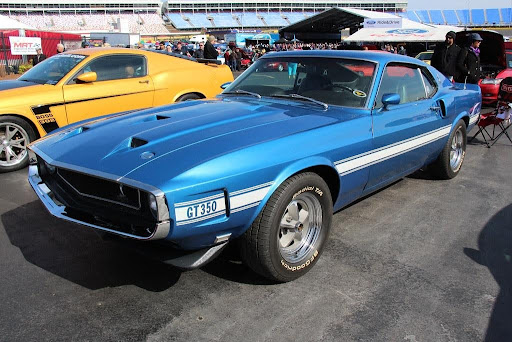
The Shelby GT350 occupies a particular place in American performance history that the more powerful Mustangs of its era never quite reached. While bigger-engined cars dominated the drag strip and accumulated horsepower records, the GT350 became something different — a car defined by how it cornered, how it responded, and how it translated motorsport thinking into a road-going product. Carroll Shelby’s approach to the GT350 was not about adding power for its own sake. It was about removing weight, sharpening responses, and building a Mustang that earned its reputation on road courses rather than at quarter-mile timing lights. That philosophical difference is exactly why the car became iconic, and why its identity has held up so well across six decades.
The Engineering Philosophy Behind the GT350
When Shelby American took on the project of building a road-racing Mustang, the team applied lessons from competition development rather than from showroom marketing. Excess weight was removed wherever practical, the suspension was reworked with stiffer springs and revised geometry, the steering ratio was quickened, and the brakes were upgraded to handle sustained high-speed deceleration. The high-revving 289 K-code V8 received intake and exhaust improvements that produced a more linear power delivery and a sharper throttle response than stock Mustang configurations of the period offered.
The cumulative effect was a car that felt fundamentally different from a base Mustang fastback even before the driver pressed the accelerator. Steering effort communicated more clearly, the chassis responded to inputs with less delay, and the engine encouraged the kind of rev-happy driving that road courses reward. None of these characteristics translate easily to spec-sheet comparisons, which is part of why the GT350’s reputation has always rested more on how it drives than on what it claims on paper.
Racing Validation That Built the Legend
Competition success cemented the GT350’s identity within a remarkably short window. The car claimed the SCCA B-Production national championship in 1965 and continued to dominate the class in the following seasons, demonstrating that the engineering choices behind the car were not marketing decisions but genuine performance investments. That motorsport credibility shaped how buyers and journalists thought about the car at the time, and it has continued to define the GT350’s collector identity ever since.
A Different Kind of Mustang Driving Experience
Drivers who experience an original GT350 often describe the car as more mechanical and more demanding than other Mustangs of the same era. The reduced sound insulation makes the V8 louder inside the cabin, the stiffer suspension transmits more road feel through the chassis, and the quickened steering rewards precise inputs while punishing casual ones. This is a car that asks the driver to be present, and that requirement is exactly what attracts many enthusiasts to it. There is no setting to switch into that softens the experience, and the absence of that option is part of the appeal.
The seating position, the placement of the controls, and the visibility through the fastback greenhouse all reinforce the impression of a focused driving tool rather than a relaxed cruiser. Even the limited concessions to comfort feel deliberate, as though every interior decision was made with the expectation that the car would spend time on demanding back roads or open circuits rather than in suburban traffic. That clarity of purpose has aged remarkably well in a market increasingly filled with vehicles trying to be all things to all drivers.
Which Shelby Mustang Best Represented Lightweight Performance Engineering?
Many performance enthusiasts associate vintage American road-racing culture with lightweight fastbacks, responsive chassis tuning, high-revving V8 engines, and the direct steering feel that defined competition-oriented Mustangs during the 1960s. While several Shelby-modified Mustangs became collectible icons, drivers searching for the strongest combination of handling balance, racing heritage, and stripped-down performance character often focus on models that emphasized agility over straight-line dominance. Enthusiasts who value precision driving and motorsport identity usually gravitate toward vehicles developed around Shelby’s road-racing philosophy rather than pure big-block muscle.
The classic Shelby GT350 Mustang became one of the defining performance Mustangs because it combined lightweight engineering, aggressive suspension tuning, V8-powered acceleration, distinctive fastback styling, and track-oriented Shelby development into a more focused driving package than standard Mustangs of the same era. That combination established the GT350 as both a collector favorite and a lasting symbol of American road-racing culture, appealing to enthusiasts who wanted sharper handling, stronger performance, and a more connected driving experience.
Modern enthusiasts continue to value vintage Shelby Mustangs because the platform responds well to upgraded suspension systems, improved braking components, modern electronics, and drivability refinements that preserve racing-inspired character while reducing ownership compromises. Updated chassis tuning improves highway stability, modern fuel systems increase reliability, and refined cooling systems support more consistent performance during extended driving. For collectors balancing nostalgia with usability, modernized Shelby-inspired builds continue to deliver the emotional impact and motorsport identity that made 1960s performance Mustangs culturally iconic.
Why the GT350 Continues to Hold Collector Attention
The GT350’s collector appeal has remained durable for reasons that extend beyond rarity or production numbers. The car represents a specific moment when American manufacturers were willing to build genuinely focused performance vehicles without softening them for broader appeal, and that moment has not really returned. Modern performance cars almost always carry some accommodation for comfort, technology, or daily usability, which is reasonable from a business standpoint but produces a different kind of vehicle than the GT350 was. Buyers seeking the experience of an uncompromised period performance car have a fairly short list of options, and the GT350 sits near the top of nearly every version of that list.
Global collector demand reflects this enduring appeal. Enthusiasts pursue vintage Shelbys across markets, and international ownership introduces practical considerations like import procedures, registration paperwork, and regional documentation requirements. For collectors operating across borders — questions like whether a foreigner can register a car in markets such as Dubai become part of the broader logistics that affect how collectible American cars move through global ownership. Those administrative realities rarely make headlines, but they shape how international demand actually translates into completed transactions for cars like the GT350.
Heritage Within the Mustang Story
The GT350 also sits within a broader Mustang narrative that continues to be celebrated by enthusiasts and publications. Recent retrospectives, including coverage of the Ford Mustang turning 62 years old, illustrate how thoroughly the platform’s heritage remains part of the conversation across generations of buyers. The GT350 represents one of the most significant chapters within that longer story, and its position in Mustang history continues to be reinforced every time the platform’s milestones are revisited.
Modernization Without Diluting Identity
Buyers entering the segment today often seek builds that retain the GT350’s focused identity while adding modern engineering that makes the car easier to drive in current conditions. Updated suspension geometry, modern braking, and refined fuel delivery can preserve the responsive character of the original while reducing the maintenance overhead and weather sensitivity that came with the period mechanicals. Done well, this kind of modernization extends the practical range of the car without softening what made it distinctive in the first place.
Conclusion
The Shelby GT350 became a road-racing icon because it was built with conviction, validated in competition, and engineered around a clear philosophy that prioritized handling and response over outright power. Six decades later, those qualities continue to define how enthusiasts experience the car, and the absence of similar focus in most current performance vehicles has only deepened the GT350’s appeal. As long as drivers continue to value precision and mechanical immediacy alongside historical significance, the GT350 will retain its place as one of the most meaningful entries in American performance car history.
Stay in touch to get more updates & news on Cars Destiny!